Implementing LuitBiz BPM

Simple, Structured & Business-Friendly BPM Implementation

Implementing BPM software should improve business operations - not create complexity.

LuitBiz BPM is designed for fast and structured implementation, helping organizations automate workflows, streamline approvals, and optimize operations without long deployment cycles.

From workflow setup to user onboarding, LuitBiz BPM makes business process automation simple, scalable, and easy to manage.
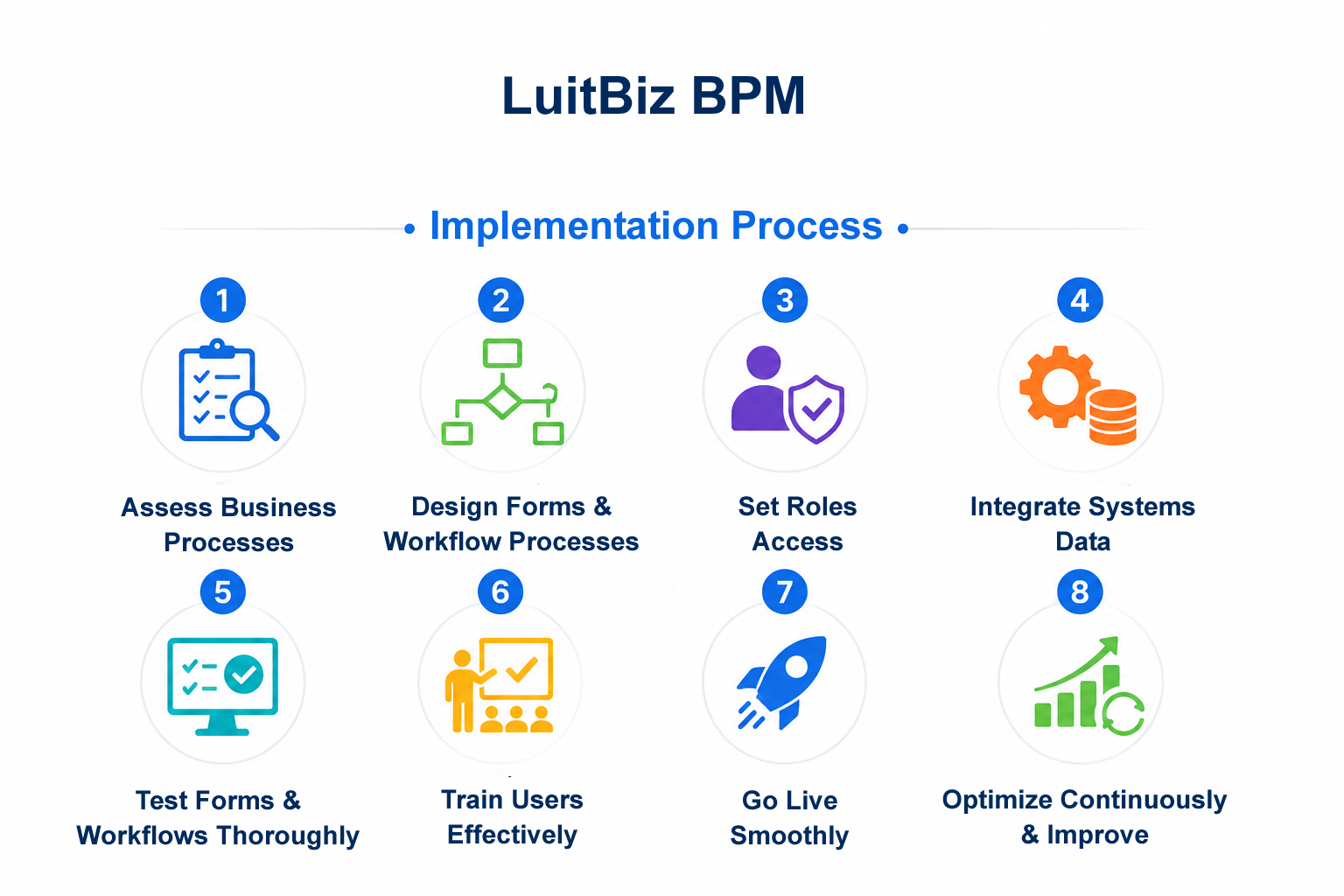

LuitBiz BPM Implementation Process


Step 1: Business Process Assessment

Every successful BPM implementation starts with understanding existing workflows and operational challenges.

What Happens
  • Identify forms and associated manual and repetitive workflows
  • Analyze approval and operational bottlenecks
  • Understand departmental process requirements
  • Define automation goals and priorities
  • Map existing business processes
Business Benefit:
  • Clear implementation roadmap
  • Better workflow alignment
  • Faster process optimization

Step 2: Forms & Workflow Design & Configuration

LuitBiz BPM forms & workflows are configured based on your operational requirements.

What Happens
  • Configure forms and their workflow stages and approvals
  • Define business rules and routing logic
  • Set notifications and escalation rules
  • Customize workflows for departments
  • Standardize operational processes
Business Benefit:
  • Faster workflow automation
  • Improved process consistency
  • Reduced manual coordination

Step 3: User Roles & Access Setup

Role-based access ensures secure and structured workflow management.

What Happens
  • Define users and workflow permissions
  • Configure approval hierarchies
  • Set department-level access controls
  • Assign workflow responsibilities
  • Establish secure operational access
Business Benefit:
  • Improved process security
  • Better accountability
  • Controlled workflow access

Step 4: System Integration & Data Setup

LuitBiz BPM integrates smoothly with business operations and existing systems.

What Happens
  • Configure forms and workflow-related data structures
  • Set up document and process records
  • Integrate with operational systems if required
  • Centralize workflow visibility
  • Prepare workflows for live usage
Business Benefit:
  • Unified operational forms & workflows
  • Better data visibility
  • Improved coordination across systems

Step 5: Testing & Workflow Validation

Before deployment, forms and workflows are validated to ensure smooth operation.

What Happens
  • Test forms and approval workflows and routing
  • Validate notifications and escalations
  • Check process visibility and tracking
  • Identify workflow improvements
  • Ensure process accuracy
Business Benefit:
  • Reduced implementation errors
  • Smooth workflow execution
  • Improved operational reliability

Step 6: User Training & Process Adoption

Successful BPM implementation depends on user adoption and process clarity.

What Happens
  • Train users on workflow usage
  • Explain approval and tracking processes
  • Demonstrate dashboards and visibility tools
  • Improve process understanding
  • Support operational readiness
Business Benefit:
  • Faster user adoption
  • Reduced operational confusion
  • Improved workflow efficiency

Step 7: Go-Live & Workflow Deployment

Once workflows are validated, the BPM platform is deployed for business operations.

What Happens
  • Activate automated workflows
  • Enable live approval routing
  • Monitor workflow execution
  • Track operational process performance
  • Ensure workflow continuity
Business Benefit:
  • Faster operational execution
  • Real-time workflow automation
  • Improved process control

Step 8: Continuous Optimization & Process Improvement

Business processes evolve - and BPM software should evolve with them.

What Happens
  • Monitor workflow performance
  • Identify operational bottlenecks
  • Improve automation efficiency
  • Update workflows as business needs change
  • Expand automation across departments
Business Benefit:
  • Long-term process optimization
  • Better operational agility
  • Scalable workflow automation

BPM Implementation Made Easy with LuitBiz BPM

Implementing BPM software should help businesses move faster - not slower.

LuitBiz BPM provides a structured, easy-to-manage implementation approach that helps organizations automate workflows, streamline operations, and improve process visibility with minimal complexity.

From workflow configuration to enterprise-wide automation, LuitBiz BPM helps businesses implement process automation quickly and efficiently.

Simplify workflows, automate approvals, and scale operations with LuitBiz BPM

👉 Get started with LuitBiz BPM and simplify workflow automation with a fast, structured, and business-friendly implementation process.

Frequently Asked Questions

How long does BPM implementation take?

Implementation timelines depend on workflow and forms structure complexity, number of departments, and customization requirements.

Is LuitBiz BPM easy to implement?

Yes. LuitBiz BPM is designed for structured and business-friendly implementation with configurable workflows and simplified deployment.

Does LuitBiz BPM support workflow customization during implementation?

Yes. Forms, workflows, approvals, notifications, and routing rules can be customized based on business requirements.

Can LuitBiz BPM integrate with existing business systems?

Yes. LuitBiz BPM supports integration and centralized workflow visibility across business operations.

Does LuitBiz BPM provide training and onboarding support?

Yes. User onboarding, workflow training, and operational guidance help organizations adopt BPM processes efficiently.